




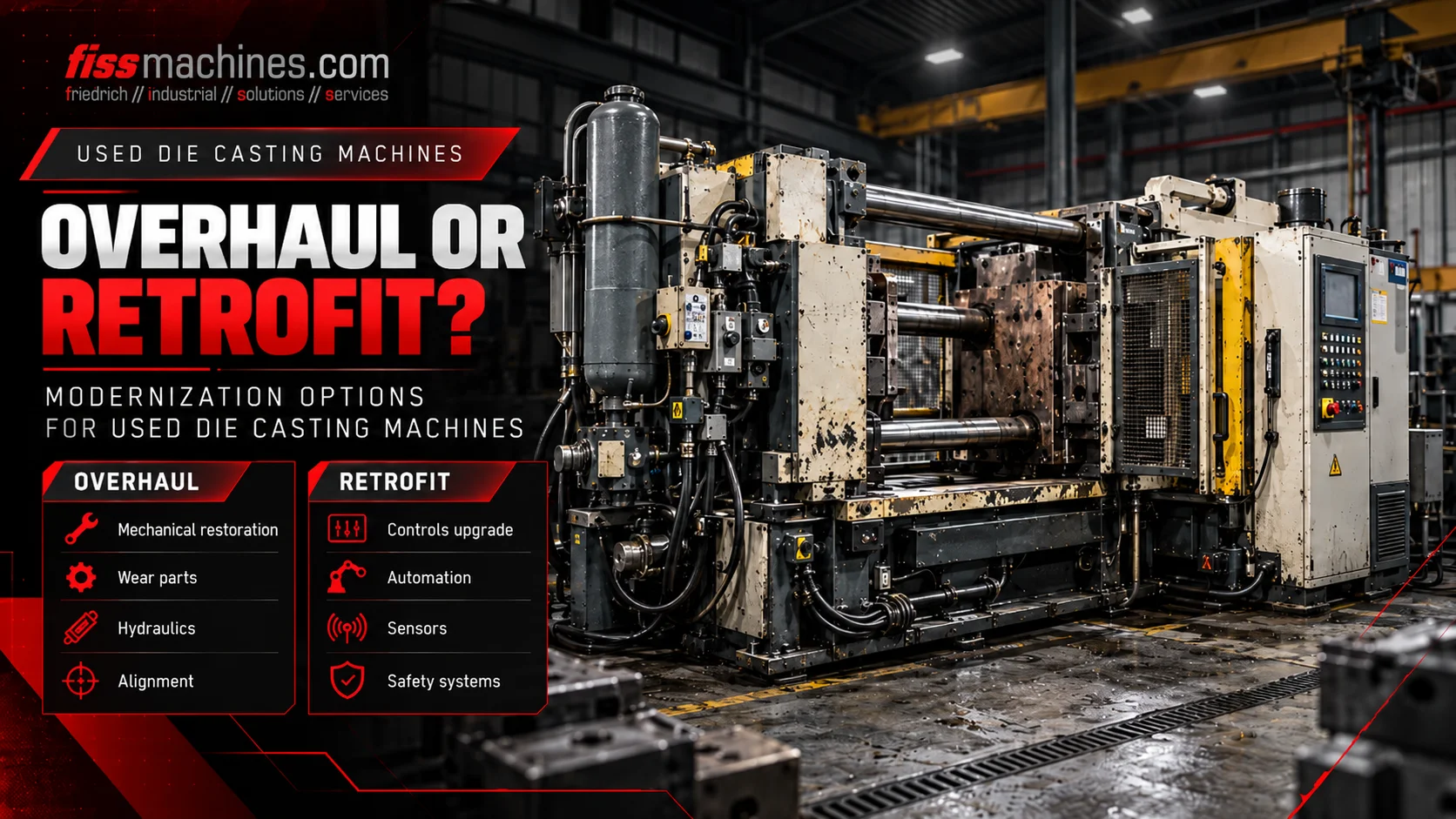
Overhaul or Retrofit? Modernising Used Foundry Machines
A used die casting machine or furnace often has a robust structure that can run for many more years. What limits it is usually something else: worn hydraulics, an obsolete control for which spare parts are hard to find, or a safety concept that no longer matches current expectations. "Overhaul" and "retrofit" are often used as if they meant the same thing. They do not, and confusing them leads to wrong budgets and wrong expectations.
What Is the Difference Between Overhaul and Retrofit?
An overhaul restores the machine's mechanical, hydraulic and electrical condition, largely within its original design: seals, cylinders, pumps, valves, guides and wear parts are inspected, repaired or replaced. A retrofit changes the design, typically by replacing the control, drives, sensors or shot control with current technology.
Both have to be followed by a safety review. Whether a modified machine meets the requirements at its place of use is not automatic; it depends on the scope of the changes and has to be assessed and documented.
What an Overhaul Covers
An overhaul starts with a structured inspection and ends with a function test. In between, the scope can range from replacing a few seals to dismantling the machine completely. Terms such as "partial overhaul" and "full overhaul" are not standardised, so the actual list of work matters more than the label.
Typical scope on a die casting machine
- Hydraulic cylinders resealed, rods and bores checked
- Pumps, valves and filters inspected or replaced, oil changed
- Accumulators inspected according to applicable rules
- Platen parallelism, tie bars and guides measured
- Toggle bushings and pins checked on toggle machines
- Shot cylinder, shot sleeve mounting and coupling inspected
- Cooling, lubrication and electrical wiring checked
An overhaul is the right approach when the structure is sound and the existing control still works reliably and can be supported with spare parts. It preserves the machine's known behaviour and documentation.
When a Retrofit Makes Sense
Controls age faster than steel. A machine may be mechanically fit, but its control can no longer be repaired economically, or it cannot provide the data and interfaces a modern cell expects. A retrofit then replaces selected systems with current components.
New PLC and operator panel with current software and documentation.
Valves, sensors and recording for a more repeatable shot and usable shot curves.
Pump drives or motor control updated where the hydraulic design allows it.
Signals for robots, sprayers, presses and data collection.
Retrofits are projects, not repairs. They need a specification, software engineering, commissioning and new documentation, and they change how operators and maintenance staff work with the machine. How peripheral units connect in a cell is described in our article on automation in the die casting cell.
Safety Revalidation: Not Automatic
Every overhaul and especially every retrofit touches safety-related functions: guards, interlocks, emergency stop, two-hand controls, and the behaviour of hydraulics when energy is removed. After the work, these functions have to be checked and the result documented.
Beyond testing, the scope of a modification can have legal consequences. In the European Union, a modification that was not foreseen by the original manufacturer and that affects safety, by creating a new hazard or increasing an existing risk, may be considered substantial. Whoever carries it out can then take on manufacturer obligations, including risk assessment and conformity documentation. The EU Machinery Regulation (EU) 2023/1230, which applies from January 2027, explicitly addresses such substantial modifications. Whether a specific project is affected has to be assessed case by case; operator obligations under national workplace safety rules apply in any case.
Neither an overhaul nor a retrofit makes a machine compliant by itself. Plan the safety review as part of the project from the start, with qualified people and clear responsibilities between supplier and operator.
Overhaul, Retrofit and Safety Review Compared
| Aspetto | Riconversione meccanica | retrofit di controllo | Revisione della sicurezza |
|---|---|---|---|
| Obiettivo | Ripristinare condizioni e affidabilità | Sostituire sistemi obsoleti, aggiungere funzioni | Confermare operatività sicura e documentarla |
| Modifica del design | Per lo più nessuna | Sì, nei sistemi modificati | Possibile, se necessarie misure |
| Principali rischi | Danni nascosti rilevati durante lo smontaggio | Scope creep, software, tempo di collaudo | Rilevamento tardivo di misure mancanti |
| Documentazione | Ispezione e rapporti di lavoro | Nuovi schemi di circuito, software, manuali | Valutazione del rischio, verbali di test |
| Trigger tipico | Usura, perdite, processo instabile | Scarsità di pezzi di ricambio, esigenze di dati | Qualsiasi modifica, relocation, nuovo sito |
Come decidere: Cinque domande
La struttura è sana?
Crepe nelle piastre o nel telaio, guide usurate o cinghie di collegamento danneggiate possono rendere l'investimento ulteriore discutibile.
Il controllo può ancora essere supportato?
Verificare disponibilità di pezzi di ricambio, backup software e persone che possono mantenerlo.
Di cosa richiede il processo?
Parti con requisiti di alta qualità possono richiedere un controllo di rifinitura o registrazione dati superiore a quello offerto dalla macchina originale.
Di cosa richiede la revisione della sicurezza?
Chiarire precocemente quali misure sono necessarie sul posto di utilizzo e chi è responsabile per esse.
Come si confrontano costi e downtime?
Confrontare l'intero progetto, inclusi collaudo e formazione, con alternative quali una macchina usata differente.
L'ispezione di una macchina prima dell'acquisto è un passaggio separato. Le domande di cui sopra riguardano cosa succede una volta che una macchina è in sito o già in produzione, e quali lavori siano realmente necessari.
Domande frequenti
Una macchina revisionata funziona come una nuova?
Non necessariamente. Una revisione ripristina la condizione definita nel suo ambito. I limiti di progettazione, le funzioni di controllo e le caratteristiche della macchina originale rimangono tali e quali a meno che anche esse vengano modificate.
Possono essere combinate revisione e retrofit?
Sì, e questo è comune. Combinarli evita lo smontaggio due volte, ma l'ambito e la revisione della sicurezza dovrebbero essere pianificati insieme.
Un retrofit è sempre migliore rispetto al mantenimento del vecchio controllo?
No. Un controllo funzionante e ben documentato con pezzi di ricambio disponibili può essere la scelta più economica. Un retrofit è conveniente dove l'obsolescenza, le esigenze di processo o l'integrazione lo rendono necessario.
Una macchina spostata ha bisogno di una nuova revisione della sicurezza?
Una revisione presso il nuovo sito è consigliabile in ogni caso, perché l'ambiente, l'attrezzatura collegata e le norme applicabili possono differire.
FISS supporta progetti di revisione e selezione delle macchine.
Parla con FISS riguardo lo stato della tua macchina e l'ambito che stai considerando, o riguardo macchine usate che potrebbero essere revisionate per soddisfare le tue esigenze.
