




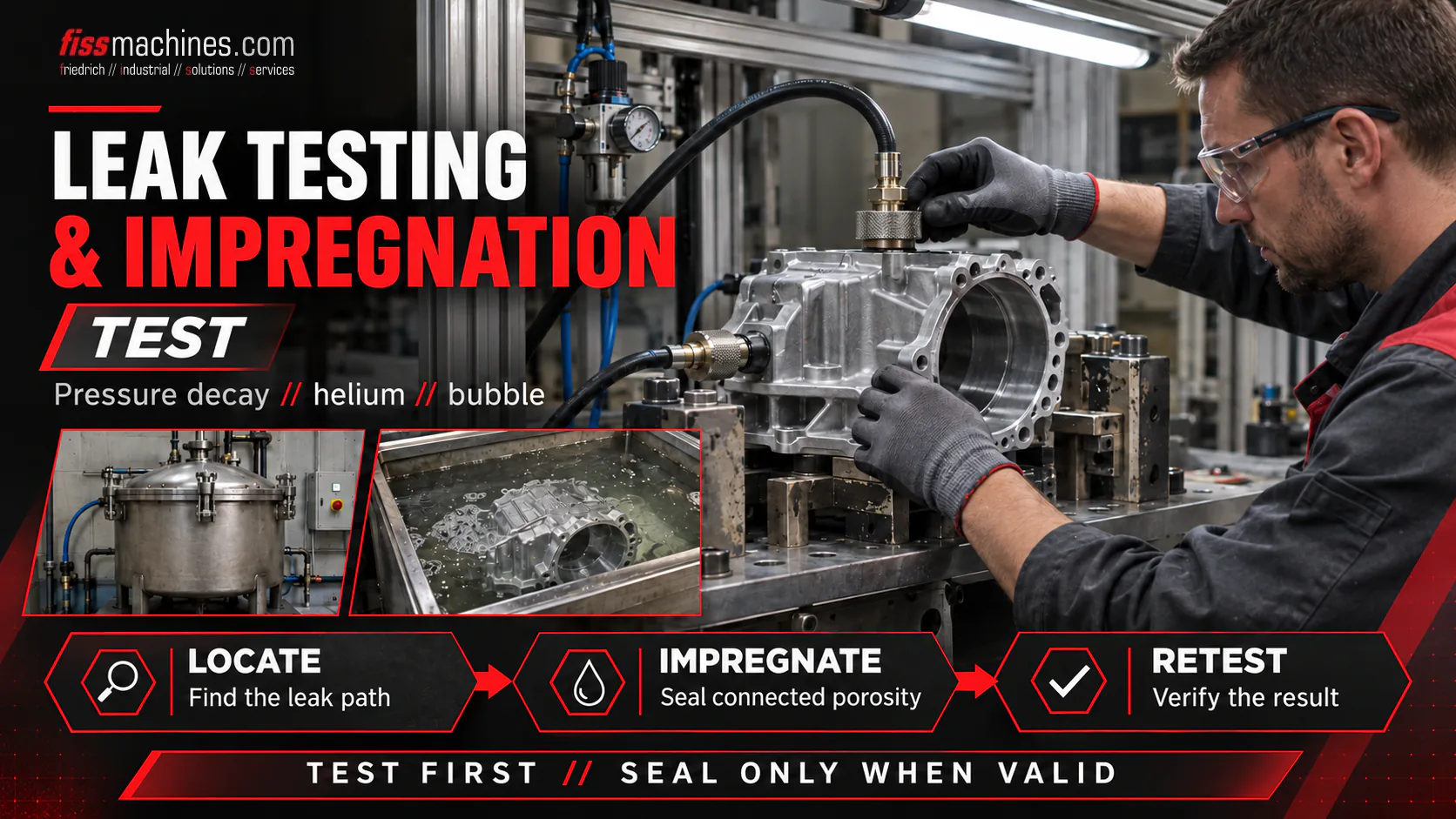
Leak Testing and Impregnation of Die Castings: Methods, Limits and Process Chain
A die-cast housing can pass visual and dimensional inspection and still leak oil, coolant or gas. Many leak paths only open when machining cuts into the wall. Leak testing and impregnation therefore belong together in the process chain of pressure-tight castings.
What Is Leak Testing of Die Castings?
Leak testing of die castings is a functional test that checks whether a casting holds a test medium within a specified leak rate. It does not show porosity itself, but whether a continuous leak path runs through a wall.
Methods range from the water bath through pressure decay, differential pressure and mass flow to helium testing. Vacuum impregnation fills leak paths with a sealant – a repair for porosity, not for structural defects.
Why Die Castings Leak
A die casting leaks when voids connect into a channel through the wall – typically gas porosity, shrinkage porosity, cold shuts or cracks. Their causes are explained in Die Casting Defects, the role of venting and vacuum in Mold Filling and Vacuum in Die Casting and hydrogen from the melt in Aluminium Melt Quality.
For leak testing, one point matters most: enclosed pores are harmless until machining opens them. Maldaner describes how initially tight castings can leak once enclosed pores are cut during machining. A test of the raw casting therefore says little about the finished part.
Leak Rate: Units and Conversion
The leak rate is the gas quantity passing through a leak per unit of time. Leak detection technology uses mbar·l/s: 1 mbar·l/s raises the pressure in a closed 1-litre vessel by 1 mbar per second. The SI unit is Pa·m³/s; 1 Pa·m³/s equals 10 mbar·l/s.
Air leak testers often display volume flow in cm³/min or sccm (standard cubic centimetres per minute). According to Pfeiffer Vacuum’s conversion table, 1 mbar·l/s corresponds to about 59.2 sccm – so a reject limit of 1 cm³/min under standard conditions is roughly 1.7·10⁻² mbar·l/s.
Leak Test Methods Compared
The choice starts with the required leak rate. Pfeiffer Vacuum names helium leak detection as the method of choice for a tightness of 1·10⁻⁷ mbar·l/s or better; above that, air methods are possible. Figures are source statements, not guaranteed values.
| Method | Principle | Sensitivity (source) | Typical use |
|---|---|---|---|
| Water bath / bubble test | Pressurised part in water; bubbles show the leak | Qualitative unless bubbles are collected (Pfeiffer) | Locating leaks, rework |
| Pressure decay | Part pressurised and isolated; pressure drop is measured | Depends on volume, pressure and stabilisation | Simple pass/fail in series |
| Differential pressure | Pressure difference against a reference volume | Compensates ambient changes acting on both sides (ATEQ, manufacturer statement) | Series testing, short cycles |
| Mass flow (Micro-Flow) | Make-up flow that holds pressure constant | 5·10⁻⁴ mbar·l/s (Pfeiffer, manufacturer statement) | Faster air test |
| Helium, vacuum chamber | Part in evacuated chamber, filled with helium; mass spectrometer | Method of choice at ≤ 1·10⁻⁷ mbar·l/s (Pfeiffer) | Tight limits, porous housings |
| Helium sniffing / spraying | Probe scans the part, or helium is sprayed onto it | Mainly for localisation (Pfeiffer) | Finding the leak |
In a 2015 Assembly Magazine article on aluminium castings, INFICON states that helium finds porosity leaks that air or underwater testing would miss, and that air methods are influenced by part volume (manufacturer statement).
Test Pressure and Temperature in Leak Testing
Test pressure follows from the part’s function; Pfeiffer Vacuum notes that parts are often tested at maximum operating pressure. Temperature is the classic error source of air methods: a casting still warm from washing heats the test air, and the pressure change looks like a leak. Pfeiffer calls stabilisation times and temperature control critical for pressure decay and recommends vacuum air tests or helium for parts presented hot.
- Define test gas, pressure, test time and reject limit together
- Bring parts to a stable temperature before air testing
- Dry parts after washing – liquid can temporarily block a leak channel
- Check the system regularly with a calibrated reference leak or master part
Vacuum Impregnation: Sealing Porosity from the Inside
Vacuum impregnation removes air from the pores and fills them with a liquid sealant that cures inside the leak path. Henkel’s LOCTITE impregnation sealants, for example, are methacrylates that cure at 90 °C or anaerobically (Henkel product sheet 2024). According to Godfrey & Wing, every variant follows four steps: impregnation, recovery of excess sealant, wash and cure.
Dry Vacuum and Pressure
Vacuum on dry parts, sealant drawn in, then overpressure of typically 70–90 psi (Godfrey & Wing). Preferred for demanding parts.
Dry Vacuum
As DVP but without overpressure: effective, but less thorough and slower (Godfrey & Wing).
Wet Vacuum
Parts are immersed before evacuation. Low-cost, suited to larger leak paths, less consistent (Godfrey & Wing).
Maldaner describes plants from manually operated small units to fully automatic lines in which baskets are rotated after each step to recover sealant (manufacturer statement). Used impregnation plants and leak testers have also appeared in FISS listings in the past; current availability can be requested via the machine search.
Leak Testing and Impregnation in the Process Chain
Godfrey & Wing recommends impregnating after machining and before plating or painting: machining can open new leak paths, and unfilled pores can cause outgassing and blemishes in the coating. A typical sequence for a pressure-tight housing:
Casting and Trimming
Shot data are recorded so that later leaks can be traced back to the process.
Machining and Washing
Final machining opens critical zones; parts are washed, dried and temperature-stabilised.
Leak Test
Integral test against the limit; failed parts are sorted and the leak located if needed.
Impregnation and Re-Test
Approved parts with porosity leaks are impregnated and tested again.
Coating and Assembly
Painting, plating or assembly only follow once the part is tight.
Limits of Impregnation and a Decision Aid
Impregnation seals porosity; it does not restore strength. Cracks, cold shuts and large shrinkage cavities remain weak points even when filled – the US military standard MIL-STD-276A accordingly refers to structurally sound castings. Whether impregnation is permitted is defined by drawing or customer specification; for safety-relevant parts it is often restricted or requires approval.
- Is impregnation permitted by drawing, specification or customer?
- Is the leak caused by porosity, or by a crack or cold shut?
- Does the required leak rate call for air or helium?
- Is there a re-test after impregnation and before coating?
- Are leak and impregnation rates fed back into the casting process?
Tightness Is Tested, Not Assumed
Reliable leak testing of die castings starts with a clearly specified leak rate – including gas, pressure and temperature – and a method that can reach it. Vacuum impregnation after machining and before coating recovers parts with porosity leaks, but only where the specification permits it and only alongside a stable casting process.
Questions About Leak Testing and Impregnation of Die Castings
Which Leak Test Method Is Best for Die Castings?
It depends on the required leak rate, part volume and cycle time. Pressure decay, differential pressure and mass flow suit higher limits in series production. For limits around 1·10⁻⁷ mbar·l/s or tighter, Pfeiffer Vacuum names helium as the method of choice.
How Do I Convert cm³/min into mbar·l/s?
According to Pfeiffer Vacuum, 1 mbar·l/s corresponds to about 59.2 sccm, so 1 cm³/min under standard conditions is roughly 1.7·10⁻² mbar·l/s. This only changes the unit; it does not turn an air limit into a helium limit.
Should Die Castings Be Impregnated Before or After Machining?
Suppliers such as Godfrey & Wing recommend impregnating after machining, because machining can open new leak paths. Impregnation should take place before painting or plating.
Can Impregnation Repair Cracks or Cold Shuts?
Impregnation can fill a leak path, but it does not restore the strength of a cracked or poorly fused wall. Such parts must be assessed against the specification, and safety-relevant parts often need customer approval.
Find Used Equipment with FISS.
FISS handles used foundry and die casting equipment. Tell us what you are looking for – we search our network for suitable machines.
Sources
Pfeiffer Vacuum GmbH: How to select the ideal leak testing method for your application, PI0457PEN, October 2019 – unit conversion, method comparison, temperature and test pressure (manufacturer statements).
Pfeiffer Vacuum GmbH: Important regulations for leak detection and tightness control, PL0020PEN, June 2019 – overview of EN/ISO leak testing standards (status as of 2019).
ATEQ Canada: F28 Light – Technology (differential pressure decay principle), ateq.ca, accessed 6 November 2026 (manufacturer statements).
S. Kurzava: Leak Testing Aluminum Castings, Assembly Magazine, January 2015, republished on inficon.com, accessed 6 November 2026 (manufacturer statements INFICON).
Godfrey & Wing: Types of Vacuum Impregnation Processes (2017) and When Should I Impregnate a Casting (2019), godfreywing.com, accessed 6 November 2026.
Henkel AG & Co. KGaA: Vacuum impregnation for die-cast and powdered metal parts, product sheet 02/2024, henkel-adhesives.com, accessed 6 November 2026.
Maldaner GmbH: Problem Porosität and Imprägnieranlagen, maldaner.de, accessed 6 November 2026 (manufacturer statements).
MIL-STD-276A: Impregnation of Porous Nonferrous Metal Castings, 30 December 1992, listed via everyspec.com, accessed 6 November 2026.
